In the golden age of prestige television, few franchises have captured the American imagination quite like Taylor Sheridan’s Yellowstone universe. With “1883,” Sheridan delivered a poetic, harrowing migration epic. “Yellowstone” itself has become a modern Western touchstone. “1923,” the much-anticipated bridge between these worlds, promised to carry the Dutton saga forward with the gravitas of Helen Mirren and Harrison Ford, the sweep of the Montana plains, and the haunted legacy of American expansion. Yet as the curtain falls on its second and final season, “1923” finds itself at the center of a storm—one less of cattle and snow, and more of audience discontent.
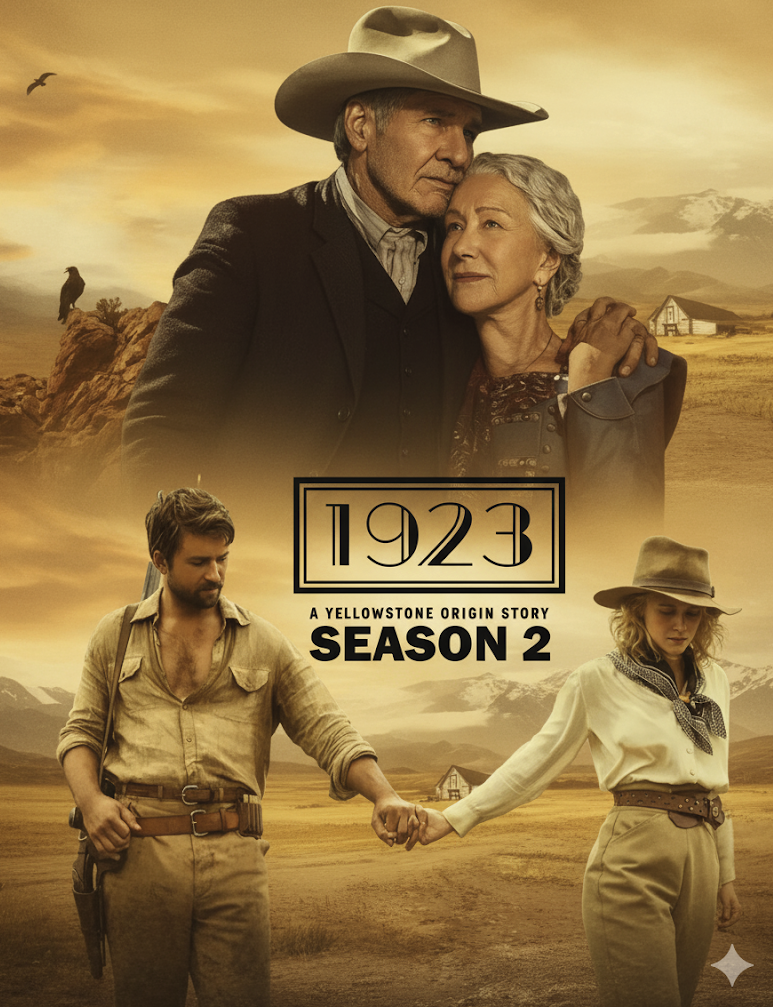
From the outset, “1923” was never going to be a simple story. Sheridan, who both wrote and co-produced the series, set his sights on the turbulence of the early twentieth century: Prohibition, drought, the Great Depression’s shadow, and the violence that so often undergirded the myth of the West. The show’s first season was lauded for its lush cinematography, its willingness to dwell in silence and suffering, and for performances that, at their best, crackled with lived-in authenticity. Mirren’s Cara Dutton, in particular, was a revelation—a matriarch both tender and terrifying, whose grief was as wide as the landscape itself. Ford’s Jacob Dutton, grizzled and weary, anchored the series with a stoic melancholy.
But as the narrative galloped into its second season, the center could not hold. The show’s central romance—between Brandon Sklenar’s war-haunted Spencer Dutton and Julia Schlaepfer’s luminous Alexandra—became the axis around which much of the story spun. Their odyssey, from Africa’s sun-bleached savannahs to the blizzards of Montana, was designed as a grand, star-crossed epic. Yet, for many viewers, the journey’s end felt less like tragedy and more like narrative betrayal.
The Reddit threads, often a barometer of contemporary fandom, are ablaze with frustration. “Everything about it was contrived,” laments one user, echoing a sentiment that reverberates through dozens of comments. Much of the ire centers on Alexandra’s fate: after surviving shipwrecks, attacks, and heartbreak, she succumbs to hypothermia in a sequence many found both avoidable and unconvincing. “She went through ALL that to be with Spencer and fought for her baby to live, just to give up because she faced another struggle. I don’t get it,” writes another. It is not Alexandra’s death alone that stings, but the sense that her arc—so painstakingly constructed—was sacrificed for shock rather than meaning.
Sheridan’s defenders might argue that the West was never fair, that tragedy is the coin of the realm. Indeed, the show’s creative team has spoken about the desire to avoid “Disney endings,” to reflect a world where “people die, things continue, no matter how hard or how much time and effort you put in.” There is truth in this. Yet, as another Redditor astutely observes, “A story can let its characters die, fail, or leave huge questions, and still feel satisfying. It’s about the craft, not the outcome.” “1923”’s finale, in its rush to conclude, left many threads dangling and emotional investments unfulfilled.
This is not to say the show was without merit. On the contrary, when “1923” leans into the elemental—Mirren’s Cara defending her family’s home with a rifle from the attic, the stark beauty of the Montana landscape, the rawness of grief—it achieves a kind of grandeur. The shootouts, the quiet moments of connection, and the slow-burn tension between family and fate are all rendered with skill. Jerome Flynn’s Banner Creighton, a Scottish sheepherder turned antagonist, is given a surprisingly nuanced arc, his final moments tinged with regret and resolve.
Yet these strengths are too often buried beneath a heap of excess. The second season, in particular, is weighed down by violence that veers into the gratuitous. The abuse suffered by Alexandra, by the show’s Indigenous characters, and by the sex workers in Donald Whitfield’s orbit is depicted with a relentless, almost voyeuristic intensity. While Sheridan and his cast have defended this as a reflection of historical reality, many critics and viewers alike have questioned the purpose of such relentless suffering, especially when narrative payoff is so meager. “Real life is hateful enough,” one fan wrote. “Bring back hopeful endings.”
The show’s structure, too, has come under fire. The parallel storyline of Teonna Rainwater—an Indigenous woman fleeing the horrors of a Catholic boarding school—was lauded for its performances but criticized for its lack of integration with the Dutton saga. “It felt like a completely separate show, which is frustrating because it deserved more integration,” one Redditor noted. The sense of disconnection, of stories running on parallel tracks but never truly intersecting, left the series feeling less like a tapestry and more like a patchwork.
In interviews, the cast has spoken of the challenges and joys of filming in Montana’s unforgiving wilds. Harrison Ford, in particular, has described the experience as “a return to something elemental,” a chance to inhabit a world where survival is never guaranteed. Schlaepfer, whose performance as Alexandra is perhaps the show’s most affecting, has spoken of the emotional toll of her character’s journey—and of her own surprise at the script’s final turn. “I wanted Alexandra to survive,” she admitted, “but I understand the logic of the world Taylor created. It’s a world where love is always at risk.”
Sheridan, for his part, has remained largely silent in the face of the finale’s backlash. His ethos—one of narrative ruthlessness, of refusing to coddle his audience—has always been polarizing. In “1923,” this approach yields moments of genuine power, but also of alienation. The show’s final image—a ballroom where Spencer and Alexandra dance in eternity, somewhere between memory and myth—is as beautiful as it is hollow. It asks us to believe in transcendence, even as it denies us catharsis.
In the end, “1923” is a show at war with itself: ambitious, beautifully made, and occasionally brilliant, but also hobbled by its own excesses. It is a Western for our time—restless, unresolved, and unwilling to grant easy answers. Perhaps that is the point. But as the dust settles on the Duttons’ latest chapter, one is left with the uneasy sense that, in its pursuit of authenticity, “1923” lost sight of the very humanity that made its predecessors sing.